Common Household Pests in New Jersey: How to Identify Them, Why They Invade, and What to Do

Finding a bug, mouse dropping, or strange scratching sound in your home can make you wonder how serious the problem really is.
Is it just one pest that wandered inside?
Or is it a sign that more are hiding somewhere nearby?
That distinction matters.
Common household pests in New Jersey don't all behave the same way. Ants may be searching for food or moisture. Rodents may be looking for shelter. Termites can quietly damage wood. Cockroaches can hide in places that are difficult to see.
That's why we don't believe good pest control starts with spraying whatever you happen to find.
It starts with identifying the pest, understanding why it is there, finding what is attracting it, and addressing the conditions that allow it to stay.
New Jersey homeowners also have to deal with changing seasons, older homes, wooded properties, dense neighborhoods, basements, crawl spaces, and plenty of potential entry points.
In this guide, we'll look at the most common household pests in New Jersey, the warning signs to watch for, what these pests may tell you about your home, and when professional pest control makes sense.
Why New Jersey Homes Attract Household Pests

Pests aren't usually entering your home randomly.
They're looking for the same basic things every living creature needs: food, water, shelter, and a suitable place to reproduce.
The U.S. Environmental Protection Agency recommends focusing on those conditions as part of an Integrated Pest Management (IPM) approach. Preventing access to food, water, and shelter can make a home less attractive to pests in the first place.
Several conditions can make a New Jersey home particularly inviting.
Seasonal temperature changes
When outdoor temperatures change, pest behavior changes with them.
Spring can bring increased insect activity. Summer creates warm, favorable conditions for many insects. As temperatures fall in autumn, rodents and other pests may look for protected indoor spaces.
That doesn't mean every pest appears only during one season. Some can remain active inside a home throughout the year.
Moisture
Leaking pipes, damp basements, crawl spaces, condensation, and poor ventilation can create conditions that attract certain pests.
Silverfish, cockroaches, ants, and other pests may be associated with damp environments.
That doesn't mean finding one of these pests proves you have a moisture problem. It simply means recurring activity is worth investigating.
Food
Open food, crumbs, overflowing garbage, pet food, and improperly stored pantry products can give pests an easy food source.
Even small amounts can matter.
Entry points
A pest doesn't need a wide-open door to get inside.
Cracks around foundations, gaps around pipes, damaged screens, door gaps, vents, utility openings, and roofline openings can all provide access.
Rodents deserve special attention here. The CDC notes that mice can fit through holes about 1/4 inch (6 millimeters) in diameter.
Shelter
Once inside, pests can find plenty of hiding places.
Basements, attics, wall voids, cabinets, garages, crawl spaces, cluttered storage areas, and insulation can all provide shelter.
That's why simply killing the pest you see may not solve the underlying problem.
The Most Common Household Pests in New Jersey
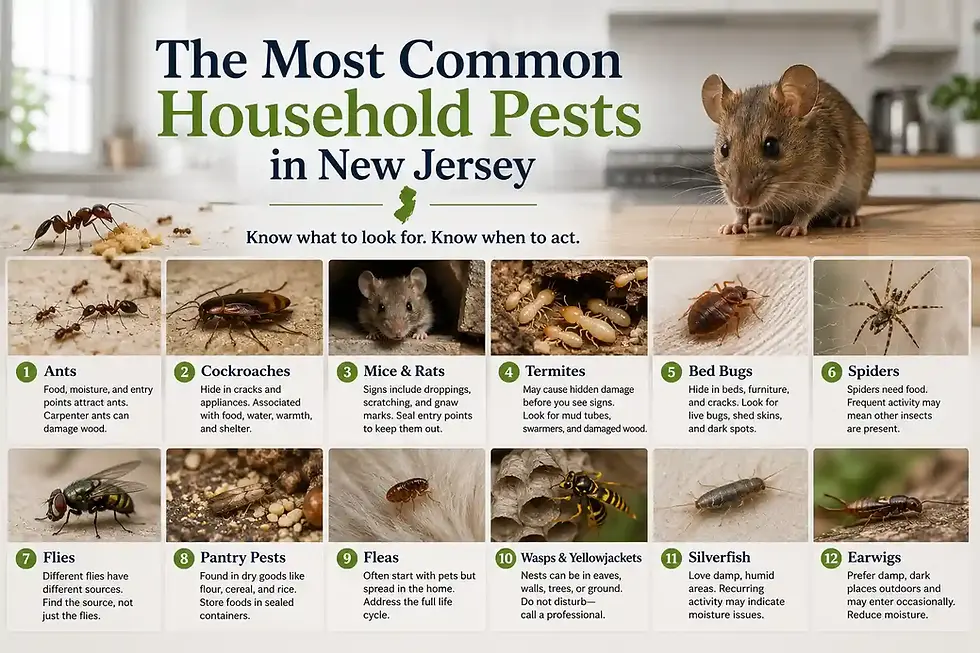
Let's look at the pests homeowners are most likely to encounter and, more importantly, what their presence can mean.
1. Ants
Ants are among the most common household pests.
You may notice them marching across a kitchen counter, gathering around a sink, or appearing near doors and windows.
The important question isn't just, "How do I kill these ants?"
It's:
Why are they here?
Ants may be attracted by food, water, moisture, or accessible entry points.
Carpenter ants deserve particular attention because they excavate wood to create nesting galleries. Finding them repeatedly inside a home warrants closer inspection, especially when moisture-damaged wood may be present.
Signs of ant activity include:
Visible ant trails
Ants around food
Ants near sinks or plumbing
Ants entering through cracks
Carpenter ant activity near damp wood
Sawdust-like material associated with carpenter ant nesting
A few ants don't automatically mean you have a major infestation.
But repeated activity means it's worth finding the source.
2. Cockroaches
Cockroaches are more than an unpleasant sight.
They can hide in cracks, cabinets, appliances, wall voids, and other protected areas.
They're also particularly good at staying out of sight.
Common signs include:
Live or dead cockroaches
Droppings
Egg cases
Shed skins
Unusual odors
Activity around kitchens and bathrooms
Cockroaches are often associated with food, water, warmth, and shelter.
The EPA notes that pests such as cockroaches and rodents can create health concerns and that responsible pest management should address the conditions that allow them to survive rather than relying only on pesticide applications.
One important distinction
Seeing one cockroach doesn't automatically prove that your home has a large infestation.
But repeated sightings, especially during the daytime, deserve attention.
Cockroaches are often more active at night. Visible daytime activity can be a reason to investigate further.
Rodents can be surprisingly difficult to notice at first.
You may not see a mouse or rat at all.
Instead, you may notice:
Droppings
Scratching sounds
Gnaw marks
Nesting material
Damaged food packaging
Grease marks
Unusual odors
Damaged insulation
Rodents can also create health and property concerns.
The CDC explains that rodents can spread disease through contact with droppings, urine, saliva, bites, and contaminated food or air.
That's why we don't recommend ignoring recurring rodent evidence.
The first question should be:
How did they get inside?
Check around pipes, doors, windows, vents, utility lines, foundations, attics, basements, and crawl spaces.
The CDC specifically recommends sealing gaps and holes to prevent new rodents from entering.
4. Termites
Termites are different from many of the nuisance pests homeowners encounter.
You may have a termite problem without seeing termites.
That's what makes them so concerning.
Possible warning signs include:
Mud tubes
Swarmers
Discarded wings
Damaged wood
Hollow-sounding wood
Cracked or bubbling wood surfaces
Termites feed on cellulose-based materials, including wood.
If you find evidence that makes you suspect termites, don't assume the problem will disappear on its own.
A professional inspection can determine whether there is active activity, previous damage, or conditions that may increase risk.
Termites vs. carpenter ants
These pests are sometimes confused.
Carpenter ants excavate wood to create nesting areas. Termites consume wood as a food source.
If you're unsure which one you're seeing, identification matters because the control strategy can be very different.
5. Bed Bugs
Bed bugs are small, persistent, and excellent at hiding.
They can be found in:
Mattress seams
Box springs
Bed frames
Furniture
Cracks and crevices
Luggage and personal belongings
Possible evidence includes:
Live bed bugs
Shed skins
Eggs
Blood spots
Dark fecal spotting
One common mistake is assuming that every unexplained bite is a bed bug bite.
Bites alone aren't enough to reliably identify an infestation.
Look for physical evidence.
The EPA recommends an Integrated Pest Management approach for bed bugs because their biology makes control challenging, particularly because eggs can resist many treatment methods.
6. Spiders
Most spiders found around homes aren't something homeowners need to panic about.
But frequent spider activity can tell you something useful.
Spiders need food.
So if you continually find spiders, webs, or egg sacs, there may also be a healthy population of insects for them to eat.
Look around:
Basements
Garages
Attics
Windows
Exterior walls
Porches
Storage areas
Reducing insect activity and removing places where spiders can shelter can help reduce recurring activity.
7. Flies
Not every small fly is the same pest.
That matters because the source can be completely different.
Common household flies include:
House flies
Fruit flies
Drain flies
Cluster flies
Phorid flies
For example, repeatedly seeing small flies around a sink or drain should lead you to investigate the source rather than simply killing the adults you see.
The visible flies are often the symptom.
The breeding source is the real problem.
8. Pantry Pests
Have you ever opened a bag of flour or cereal and noticed tiny insects or webbing?
You may be dealing with stored-product pests.
Common examples include:
Indian meal moths
Weevils
Flour beetles
Other pantry beetles
These pests can enter through contaminated food products and spread to other stored foods.
Check:
Flour
Rice
Cereal
Pasta
Pet food
Baking ingredients
Nuts
Dry goods
Store susceptible foods in tightly sealed containers.
If you discover an infestation, inspect nearby products instead of throwing away only the package where you noticed the pest.
9. Fleas
Fleas are often associated with pets, but their life cycle makes them a household problem rather than simply a pet problem.
You may find activity around:
Pet bedding
Carpets
Upholstery
Floor cracks
Areas where pets rest
Treating only the adult fleas you see may not address the entire life cycle.
That is why persistent flea problems require a more complete approach.
10. Wasps and Yellowjackets
Stinging insects become a different kind of pest problem because safety matters.
Nests may appear around:
Eaves
Rooflines
Wall voids
Trees
Sheds
Porches
Ground-level areas
Don't disturb an active nest simply because you want to find out how large it is.
If you have allergies or the nest is near a doorway, play area, or heavily used part of the property, professional evaluation is especially sensible.
11. Silverfish
Silverfish are small, fast-moving insects with a distinctive tapered body.
They're commonly associated with damp or humid areas.
You may find them in:
Bathrooms
Basements
Attics
Storage spaces
Areas containing paper or cardboard
Recurring silverfish activity can be a reason to inspect for excess moisture.
Again, one silverfish doesn't prove that your home has a moisture problem.
Repeated sightings are the more useful clue.
12. Earwigs
Earwigs are usually associated with outdoor environments but can occasionally make their way indoors.
They prefer protected, damp areas.
You may find them around:
Gardens
Mulch
Foundation areas
Damp storage spaces
Doorways
Reducing moisture and removing outdoor harborage close to the house can make the property less attractive to them.
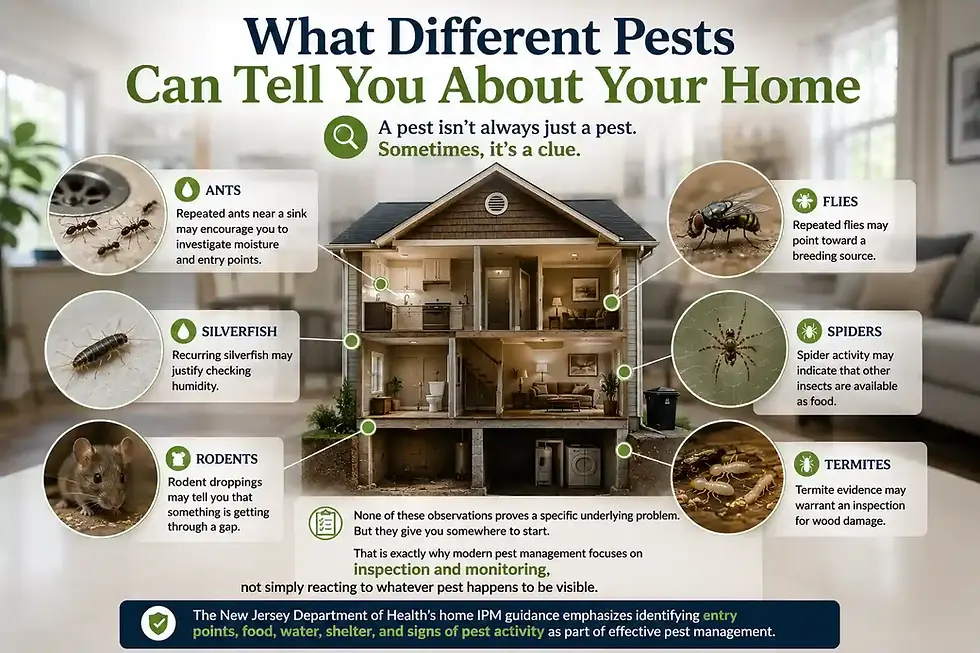
What Different Pests Can Tell You About Your Home
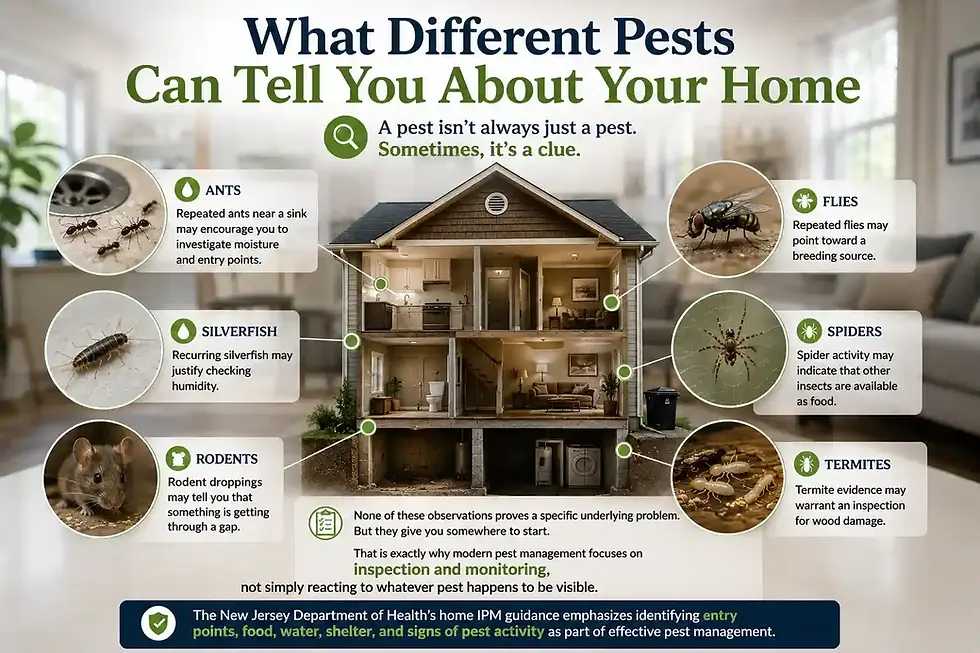
Here's where pest identification becomes much more useful.
A pest isn't always just a pest.
Sometimes, it's a clue.
Repeated ants near a sink may encourage you to investigate moisture and entry points.
Recurring silverfish may justify checking humidity.
Rodent droppings may tell you that something is getting through a gap.
Repeated flies may point toward a breeding source.
Spider activity may indicate that other insects are available as food.
Termite evidence may warrant an inspection for wood damage.
None of these observations proves a specific underlying problem.
But they give you somewhere to start.
That is exactly why modern pest management focuses on inspection and monitoring, not simply reacting to whatever pest happens to be visible.
The New Jersey Department of Health's home IPM guidance emphasizes identifying entry points, food, water, shelter, and signs of pest activity as part of effective pest management.
15 Signs You May Have a Pest Infestation
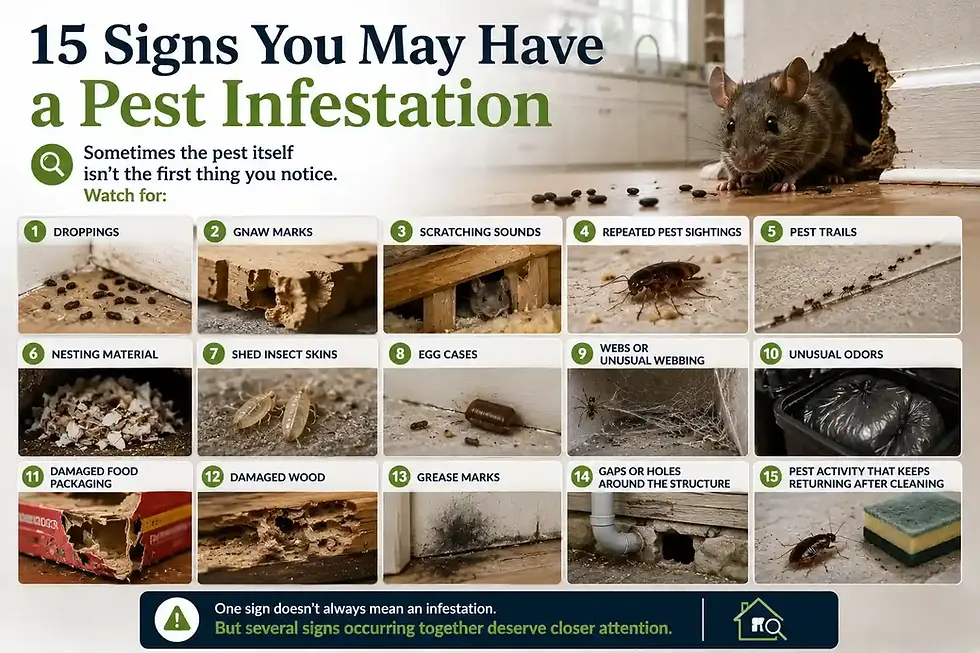
Sometimes the pest itself isn't the first thing you notice.
Watch for:
Droppings
Gnaw marks
Scratching sounds
Repeated pest sightings
Pest trails
Nesting material
Shed insect skins
Egg cases
Webs or unusual webbing
Unusual odors
Damaged food packaging
Damaged wood
Grease marks
Gaps or holes around the structure
Pest activity that keeps returning after cleaning
One sign doesn't always mean an infestation.
But several signs occurring together deserve closer attention.
Where Household Pests Hide Inside New Jersey Homes
If you want to understand pest activity, don't only look where you saw the pest.
Look nearby.
Kitchens
Check:
Cabinets
Pantries
Under appliances
Around plumbing
Garbage areas
Food storage
Bathrooms
Look around:
Pipes
Cabinets
Drains
Under sinks
Damp areas
Basements and crawl spaces
These areas can provide moisture, shelter, and numerous entry points.
Attics
Inspect:
Roofline gaps
Vents
Insulation
Stored materials
Garages
Pay attention to:
Boxes
Clutter
Door gaps
Firewood
Stored food
Walls
Wall voids can provide protected pathways for rodents and insects.
That's why seeing a pest disappear behind a wall doesn't mean the problem disappeared.
Are Household Pests Dangerous?

The answer depends on the pest.
Some are mainly nuisance pests.
Others can create health or property concerns.
Rodents, for example, can spread disease through contaminated droppings, urine, saliva, and food.
Cockroaches can contribute to allergen exposure and sanitation concerns.
Stinging insects can create immediate risks for people with allergies.
Termites and certain wood-destroying insects can threaten property.
At the same time, we don't believe homeowners should panic every time they see an insect.
Good pest control means understanding the actual risk and responding proportionately.
How to Identify a Household Pest Before Treating It

Before reaching for a spray, stop and look.
Ask:
What does it look like?
Note:
Size
Color
Body shape
Wings
Number of legs
Antennae
Where did you find it?
A pest in a pantry tells you something different from a pest in a damp basement.
What evidence is nearby?
Look for:
Droppings
Damage
Webs
Nesting material
Egg cases
Shed skins
Odors
Is the activity recurring?
One insect may be incidental.
Repeated activity is more meaningful.
If you can't confidently identify the pest, don't guess.
Incorrect identification can lead to the wrong treatment.
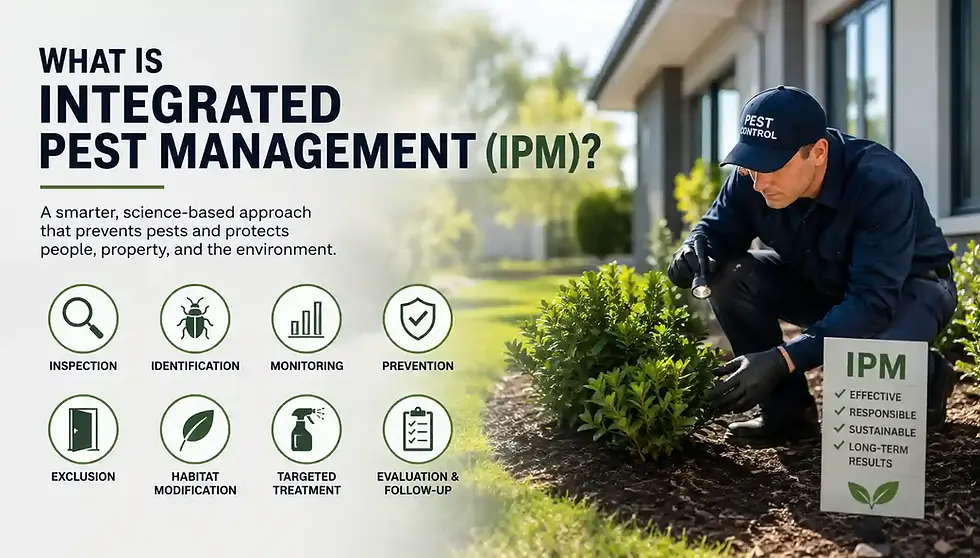
Why Integrated Pest Management Is a Better Starting Point
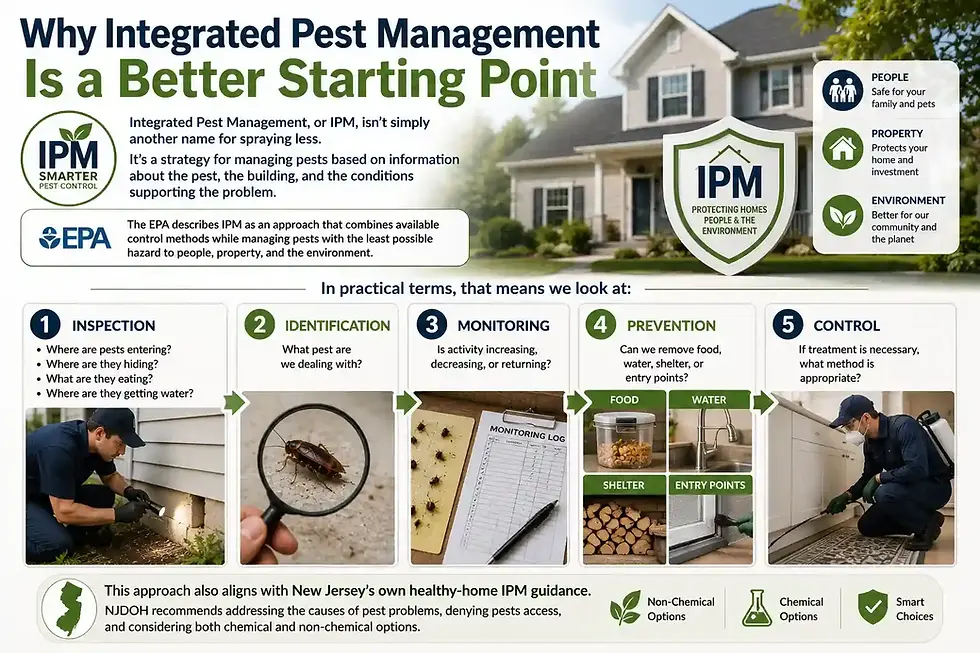
Integrated Pest Management, or IPM, isn't simply another name for spraying less.
It's a strategy for managing pests based on information about the pest, the building, and the conditions supporting the problem.
The EPA describes IPM as an approach that combines available control methods while managing pests with the least possible hazard to people, property, and the environment.
In practical terms, that means we look at:
1. Inspection
Where are pests entering?
Where are they hiding?
What are they eating?
Where are they getting water?
2. Identification
What pest are we dealing with?
3. Monitoring
Is activity increasing, decreasing, or returning?
4. Prevention
Can we remove food, water, shelter, or entry points?
5. Control
If treatment is necessary, what method is appropriate?
This approach also aligns with New Jersey's own healthy-home IPM guidance. NJDOH recommends addressing the causes of pest problems, denying pests access, and considering both chemical and non-chemical options.
How We Recommend Preventing Common Household Pests

You don't need to turn your home into a laboratory.
Start with the basics.
Remove food sources
Keep food sealed.
Clean crumbs quickly.
Empty garbage regularly.
Store pet food properly.
Keep pantry goods in sealed containers.
Reduce moisture
Repair plumbing leaks.
Address damp areas.
Improve ventilation where needed.
Don't allow standing water to remain around the property.
Seal entry points
Check around:
Doors
Windows
Pipes
Utility lines
Vents
Foundations
Roof penetrations
For rodents, even small openings can matter. The CDC recommends looking for and sealing gaps inside and outside the home.
Reduce hiding places
Keep storage areas organized.
Limit unnecessary cardboard and clutter.
Keep materials elevated when practical.
Maintain basements, garages, attics, and crawl spaces.
Maintain the exterior
Keep vegetation and debris from creating easy harborage next to the structure.
Also inspect potential entry points as part of routine home maintenance.
DIY Pest Control vs. Professional Pest Control
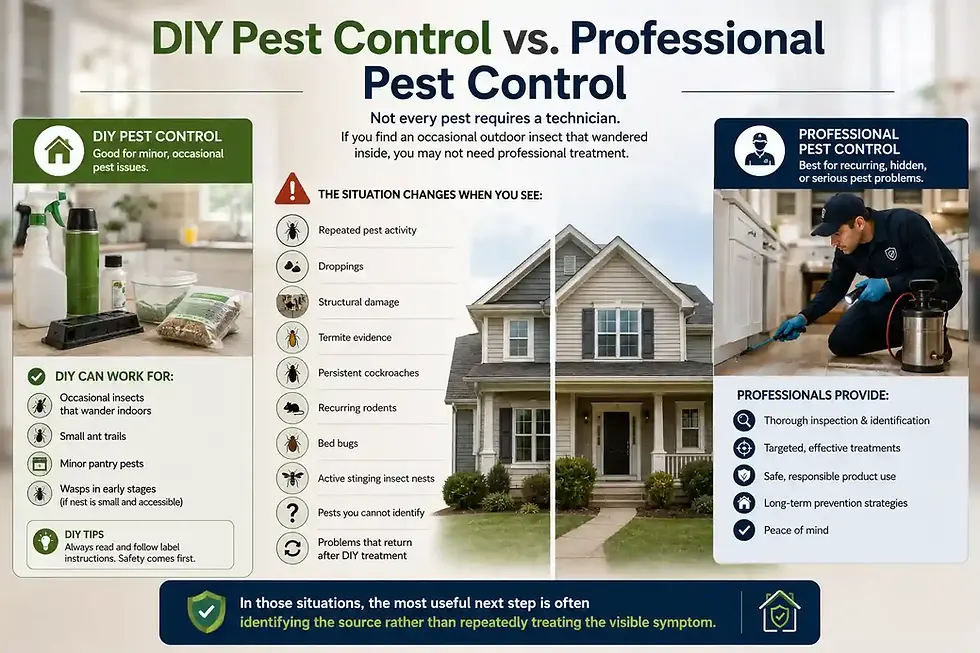
Not every pest requires a technician.
If you find an occasional outdoor insect that wandered inside, you may not need professional treatment.
But the situation changes when you see:
Repeated pest activity
Droppings
Structural damage
Termite evidence
Persistent cockroaches
Recurring rodents
Bed bugs
Active stinging insect nests
Pests you cannot identify
Problems that return after DIY treatment
In those situations, the most useful next step is often identifying the source rather than repeatedly treating the visible symptom.
When Should You Call a Pest Control Professional?
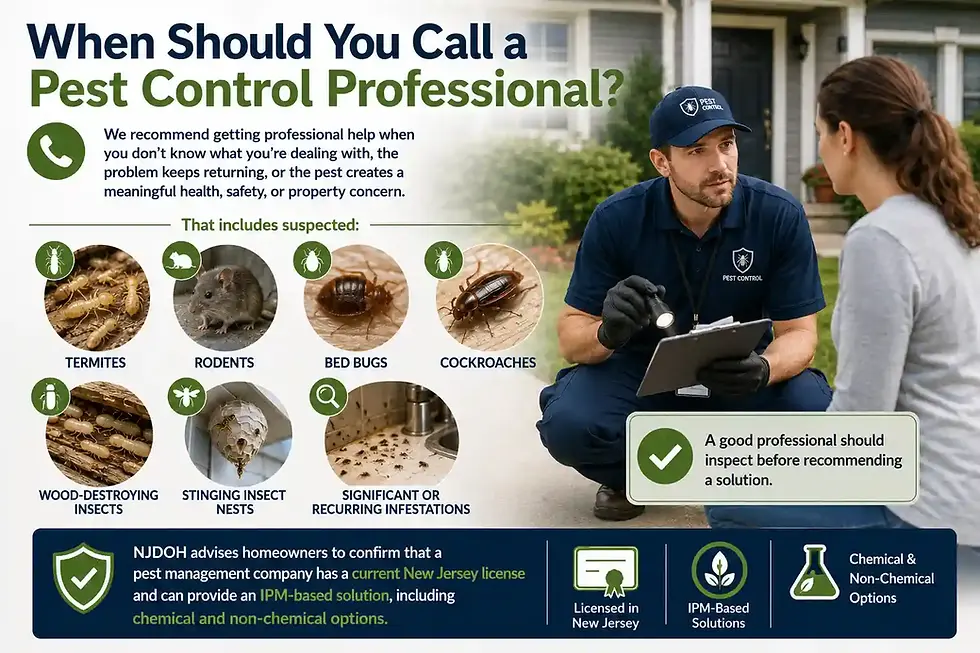
We recommend getting professional help when you don't know what you're dealing with, the problem keeps returning, or the pest creates a meaningful health, safety, or property concern.
That includes suspected:
Termites
Rodents
Bed bugs
Cockroaches
Wood-destroying insects
Stinging insect nests
Significant or recurring infestations
A good professional should inspect before recommending a solution.
NJDOH advises homeowners to confirm that a pest management company has a current New Jersey license and can provide an IPM-based solution, including chemical and non-chemical options.
What Good Professional Pest Control Should Look Like

Professional pest control shouldn't be a mystery.
We believe homeowners should understand what is being done and why.
A thorough service should involve:
Inspection → Identification → Source analysis → Treatment when appropriate → Prevention → Monitoring
The EPA also emphasizes monitoring, documentation, prevention, and communication as important parts of responsible pest management.
The goal isn't simply to make the pest disappear for a few days.
The goal is to make the property less favorable to the pest and reduce the chance of the problem returning.
Common Pest Control Mistakes Homeowners Make
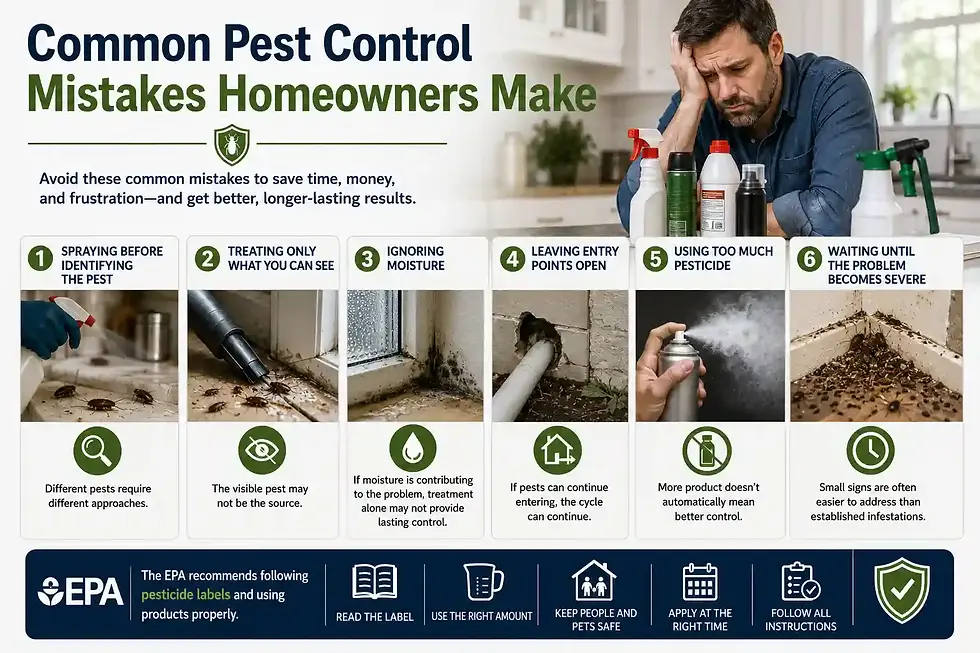
Spraying before identifying the pest
Different pests require different approaches.
Treating only what you can see
The visible pest may not be the source.
Ignoring moisture
If moisture is contributing to the problem, treatment alone may not provide lasting control.
Leaving entry points open
If pests can continue entering, the cycle can continue.
Using too much pesticide
More product doesn't automatically mean better control.
The EPA recommends following pesticide labels and using products properly.
Waiting until the problem becomes severe
Small signs are often easier to address than established infestations.
Common Myths About Household Pests

"A clean house can't get pests."
Not true.
Clean homes can still have pests because insects and rodents can enter through structural openings or arrive through food, packages, belongings, pets, or other routes.
"If I see one cockroach, there are definitely hundreds."
Not necessarily.
One sighting doesn't tell you the size of a population. Repeated activity and supporting evidence provide more useful information.
"Termites only attack old houses."
No.
Termite risk isn't determined by the age of a house alone.
"All ants are the same."
Definitely not.
Different ant species behave differently and may require different control strategies.
"Pesticides are always the fastest solution."
Not necessarily.
If the source of the problem remains, simply treating the visible pests may not solve it.
That's one reason IPM emphasizes prevention, monitoring, and addressing environmental conditions.
New Jersey Household Pest Calendar

Pest activity changes throughout the year.
Spring
Watch for:
Ants
Termites and swarmers
Flies
Early stinging insect activity
Summer
Common concerns include:
Ants
Wasps
Yellowjackets
Flies
Spiders
Outdoor pests entering homes
Fall
Pay closer attention to:
Mice
Rats
Spiders
Overwintering insects
Winter
Indoor pest activity can become more noticeable because rodents and other pests seek protected environments.
The exact timing varies by pest, weather, property conditions, and location.
Quick Household Pest Identification Chart
What You Notice | Possible Pest |
Ant trails around food or water | Ants |
Mud tubes or discarded wings | Termites |
Scratching sounds and droppings | Mice or rats |
Small dark insects in kitchens | Cockroaches |
Webbing inside dry food packages | Pantry moths |
Tiny flies around drains | Drain flies |
Evidence around mattresses | Bed bugs |
Insects around pet bedding | Fleas |
Active paper-like nest outdoors | Wasps or yellowjackets |
Silver insects in damp areas | Silverfish |
Many webs and spiders | Spiders/insect activity |
Remember: this chart is a starting point, not a substitute for professional identification.
Frequently Asked Questions About Common Household Pests in New Jersey
What are the most common household pests in New Jersey?
Common household pest concerns include ants, cockroaches, mice, rats, termites, bed bugs, spiders, flies, pantry pests, fleas, wasps, silverfish, and earwigs.
The exact pest pressure varies by season, property type, neighborhood, and environmental conditions.
What is the most common bug found in New Jersey homes?
There isn't one pest that can accurately be called the most common in every New Jersey home.
Ants, cockroaches, spiders, flies, and other insects are frequent household concerns, but pest activity varies significantly by property and season.
What pests are common in NJ during winter?
Rodents are a major winter concern because they may seek warmth, food, and shelter inside buildings.
Other indoor pests can remain active year-round when conditions inside the home support them.
How do I know if I have a pest infestation?
Look for recurring sightings, droppings, gnaw marks, nesting material, damaged food, unusual odors, egg cases, shed skins, or other evidence.
Repeated signs are more concerning than a single isolated insect.
What are the first signs of termites?
Possible signs include mud tubes, swarmers, discarded wings, damaged wood, and other evidence of termite activity.
Because termites can remain hidden, professional inspection is often the best way to determine whether activity is present.
What pests are attracted to moisture?
Several household pests can be associated with damp conditions, including silverfish, cockroaches, and some ant species.
Recurring pest activity should prompt homeowners to look for leaks, condensation, poor ventilation, or other moisture sources.
Does seeing one pest mean I have an infestation?
No.
An isolated pest may have simply entered the home.
The more important questions are whether you continue seeing pests and whether you find supporting evidence.
Should I use DIY pest control or hire a professional?
Minor, isolated pest activity may sometimes be manageable with basic prevention.
Professional help becomes more appropriate for persistent infestations, rodents, termites, bed bugs, stinging insects, structural concerns, or pests you cannot confidently identify.
How often should a New Jersey home receive pest inspections?
There isn't one schedule that fits every home.
Inspection needs depend on the property's age, construction, location, pest history, season, and risk factors.
Homes with recurring pest issues or suspected wood-destroying insects may need more frequent professional attention.
Final Takeaway: Don't Just Kill the Pest. Find Out Why It's There.
Seeing a pest in your New Jersey home can be frustrating.
But the pest itself is only part of the story.
The better questions are:
What is it?
Why is it here?
How did it get inside?
What is it eating or drinking?
Where is it hiding?
Is there damage?
Is the problem likely to continue?
That mindset is at the heart of Integrated Pest Management.
Instead of automatically reaching for the strongest treatment, we look at the whole situation. We identify the pest, inspect the property, look for food, water, shelter, and entry points, and determine what response makes sense.
That's also why professional experience matters.
At Accurate Pest Control, we take a practical approach to protecting North Jersey homes from common household pests. Our team has more than 30 years of pest-control experience and handles concerns ranging from ants, termites, rodents, cockroaches, and bed bugs to stinging insects and other common pests.
If you're seeing recurring pest activity and aren't sure what you're dealing with, getting the problem identified is a better first move than guessing.
The sooner you understand why pests are entering your home, the easier it can be to choose the right solution.